NPTE Practice Question Explained to Improve Your Clinical Reasoning and Exam Skills
· based on the channel Typical PT
Key takeaways
- NPTE questions test clinical reasoning with real case scenarios
- Correct answer requires linking exam findings to best PT intervention
- Distractors often reflect common misconceptions or incomplete reasoning
- Safety and priority actions are key to selecting the best response
- Typical PT offers free NPTE practice questions and study planners
## Understanding the NPTE Practice Question Explained
NPTE practice questions are designed to simulate realistic clinical cases, helping physical therapy candidates develop critical clinical reasoning and decision-making skills. An NPTE practice question explained thoroughly reveals how to identify key clinical findings, interpret relevant clues, and determine exactly what the question asks to choose the best answer confidently. Access free NPTE practice questions and study planners at Typical PT resources.
## Clinical Case Breakdown: Identifying Key Findings
When approaching an NPTE practice question, first carefully analyze the clinical case presented. This involves:
- Noting patient history, symptoms, and physical exam findings.
- Recognizing significant clinical signs that influence diagnosis or treatment.
- Understanding the context and what the question prioritizes—diagnosis, intervention, safety, or prognosis.
For example, a patient’s limited range of motion combined with specific neurological deficits guides you toward certain diagnoses and treatment choices. Clarifying these elements prevents confusion between similar options.
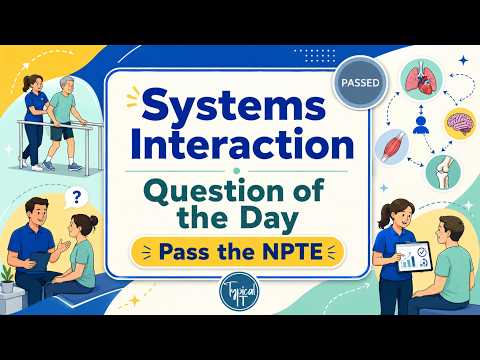
Video: NPTE Practice Question 2026 | PT & Board Review
## Clinical Reasoning: Connecting Examination Findings to Decisions
Clinical reasoning in NPTE questions requires linking the patient’s signs and symptoms to the most appropriate next step in physical therapy management. This means:
- Prioritizing safety and immediate needs first (e.g., fall risk, contraindications).
- Choosing interventions that address the primary impairments effectively.
- Considering evidence-based practice and clinical guidelines.
For instance, if a patient shows signs of acute inflammation, the best answer might be to avoid aggressive stretching and instead use modalities promoting healing. This reasoning separates the best answer from other plausible but less appropriate options.
## Answer Choice Analysis: Why the Correct Answer Stands Out
Each answer choice in NPTE questions is crafted to test your knowledge depth and clinical judgment. Understanding why the correct answer fits involves:
- Evaluating if the intervention matches the clinical presentation.
- Eliminating distractors that may seem correct but lack safety, efficacy, or priority.
- Considering timing and sequence—whether the answer is best, first, or next action.
Distractors often reflect common mistakes, like choosing a treatment that ignores patient contraindications or misinterpreting clinical signs. Recognizing these traps sharpens exam performance.
## Test-Taking Strategies for NPTE Practice Questions
To excel in NPTE practice questions, apply these strategies:
- Read each question carefully, focusing on what is specifically asked.
- Identify keywords such as BEST, FIRST, NEXT, or MOST appropriate to guide your choice.
- Prioritize patient safety and clinical urgency.
- Use elimination to remove clearly incorrect or less suitable options.
- Trust clinical reasoning over memorization alone.
These strategies help reduce confusion when two answer choices seem reasonable and improve accuracy under exam conditions.
## Applying NPTE Practice Question Explanations to Your Exam Prep
Regularly reviewing NPTE practice questions explained by experts like Typical PT enhances your ability to:
- Integrate clinical knowledge with reasoning skills.
- Recognize patterns in question formats and common clinical scenarios.
- Build confidence in selecting the correct, prioritized intervention.
Utilize the free resources and study planners available at Typical PT free resources to structure your study sessions effectively.
## Useful Links
- Free NPTE practice questions and study planners: https://typicalpt.com/pages/free-resources
## Conclusion
An NPTE practice question explained clearly helps you connect clinical findings with appropriate physical therapy decisions, improving your exam readiness and clinical reasoning. By breaking down cases, analyzing answer choices, and applying test-taking strategies, you develop skills essential for success in the NPTE. Typical PT provides valuable resources and expert explanations to guide your preparation journey. Explore their free materials to enhance your study routine and confidence.
Source: NPTE Practice Question 2026 | PT & Board Review · Markdown version
Questions & answers
What is the main benefit of reviewing NPTE practice questions with explanations?
Reviewing NPTE practice questions with detailed explanations helps you understand the clinical reasoning behind each answer, improving your ability to select the best intervention and enhancing exam readiness.
How can clinical reasoning improve my performance on the NPTE?
Clinical reasoning allows you to connect patient signs and symptoms to appropriate physical therapy decisions, ensuring you choose answers that prioritize safety and efficacy rather than relying on memorization alone.
What strategies help choose the best answer when two options seem correct?
Focus on keywords like BEST or NEXT, prioritize patient safety, eliminate distractors that ignore clinical priorities, and apply clinical guidelines to determine the most appropriate choice.
Where can I find free resources to practice NPTE questions?
Typical PT offers free NPTE practice questions and study planners on their website at https://typicalpt.com/pages/free-resources to support your exam preparation.